Moroccan Tile Courtyard
A patterned courtyard with fountain and arches.
★★★★
Free printable · PNG 2480×3508 px (A4, 300 DPI) · PDF in A4 & US Letter · No sign-up
Best for Adults
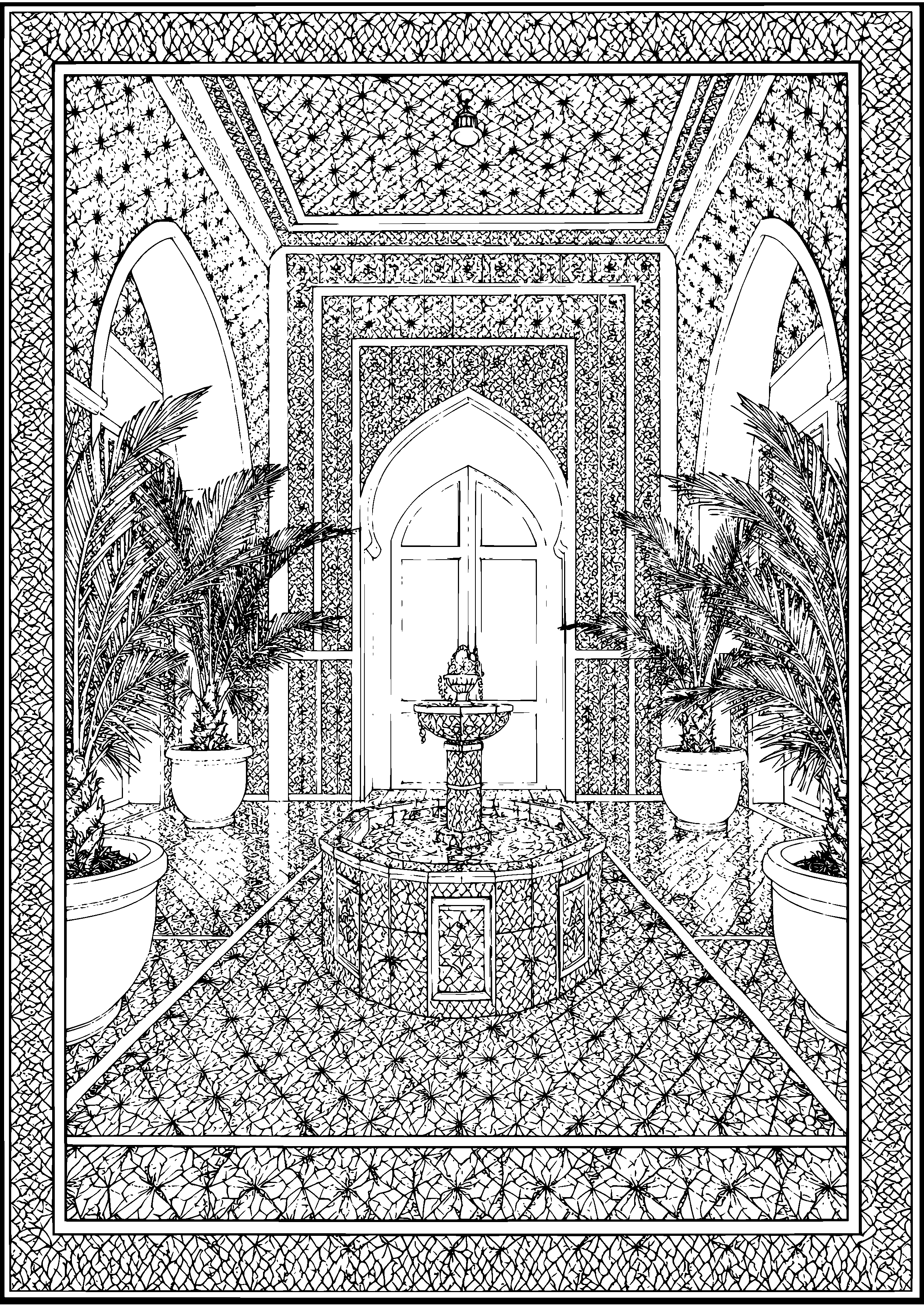
This coloring page shows a symmetrical Moroccan-style courtyard featuring an elaborate central fountain, tall pointed arches, and potted palm trees on either side. The floor, walls, and ceiling are covered in detailed geometric and mosaic patterns that offer dozens of individual sections to fill.
The black outline work is fine and intricate, framed by a thick patterned border that surrounds the entire composition. There are very few large open white spaces, making this page best suited for those who enjoy filling dense, repeating patterns.
Traditional Moroccan architecture relies heavily on zellige, which are hand-cut terracotta tiles set into plaster to create complex geometric tessellations. These courtyards, often called riads, are designed to bring fresh air, natural light, and the soothing sound of running water into the center of a home.
The arches, symmetrical layouts, and central fountains seen in this drawing reflect centuries of Islamic design traditions that emphasize balance, mathematics, and intricate detail. While this specific scene is an artist's decorative interpretation rather than a photograph, it draws directly from real architectural elements found across North Africa.
For a classic look, use deep blues, rich terracotta reds, emerald greens, and warm ochres on the tiled patterns to mimic traditional zellige work. Keeping the doorway and fountain basin in neutral off-whites or soft stone shades will help the more colorful walls and floor stand out.
If you want to try something unexpected, experiment with a monochromatic color scheme using shades of purple and teal, or use warm metallic fineliners to accent the geometric lines. Starting from the center fountain and working outward toward the frames helps prevent your hand from smudging finished areas.
Because the page contains very fine, dense patterns and thin lines, standard printer paper can easily become oversaturated if you use wet media. Printing on a heavier cardstock ensures that fineliners will not bleed through, and provides a storable surface if you prefer to use colored pencils for subtle shading.