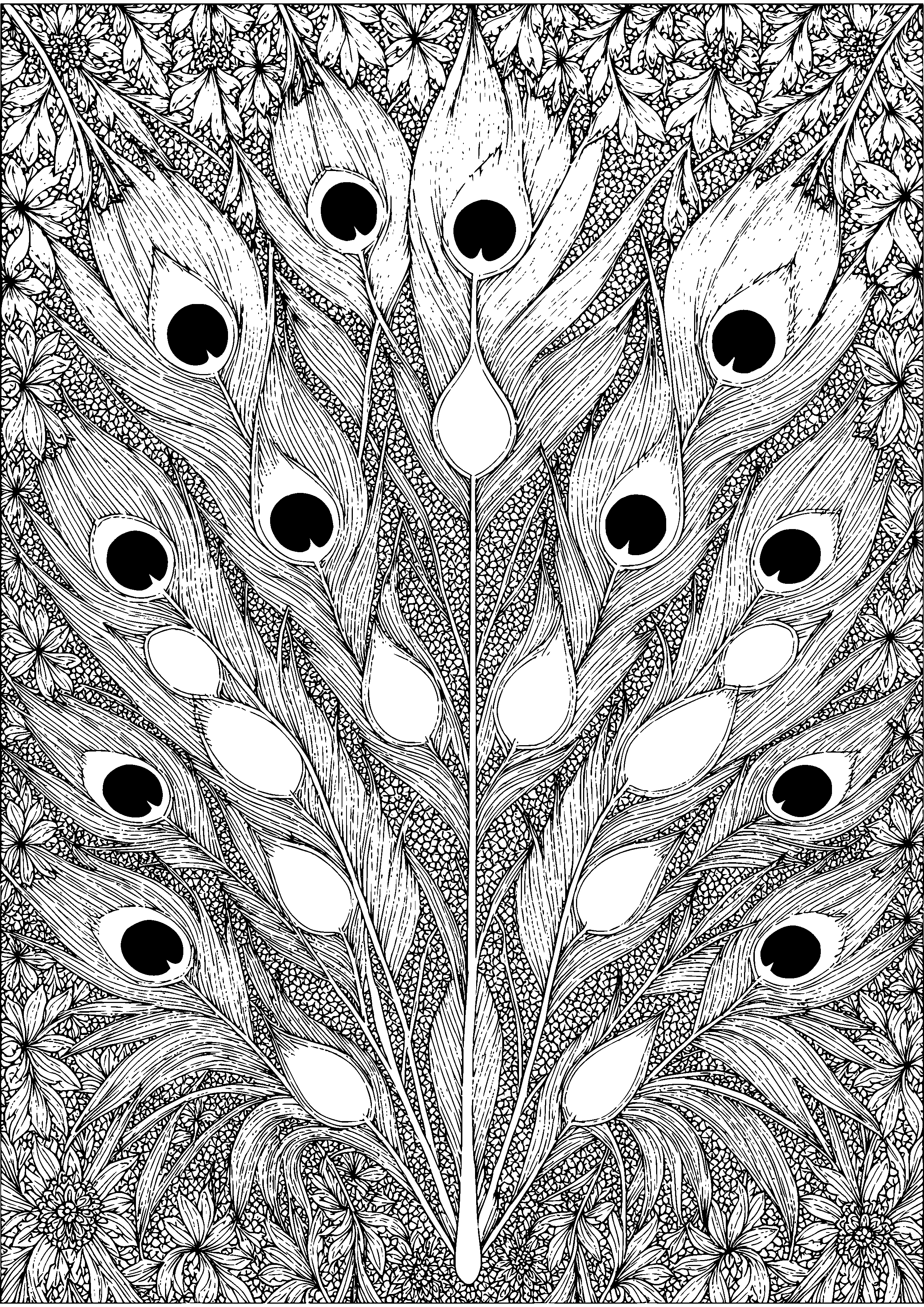
Peacock Feather Fan
A fan of intricate peacock feathers.
★★★★
Free printable · PNG 2480×3508 px (A4, 300 DPI) · PDF in A4 & US Letter · No sign-up
Best for Adults
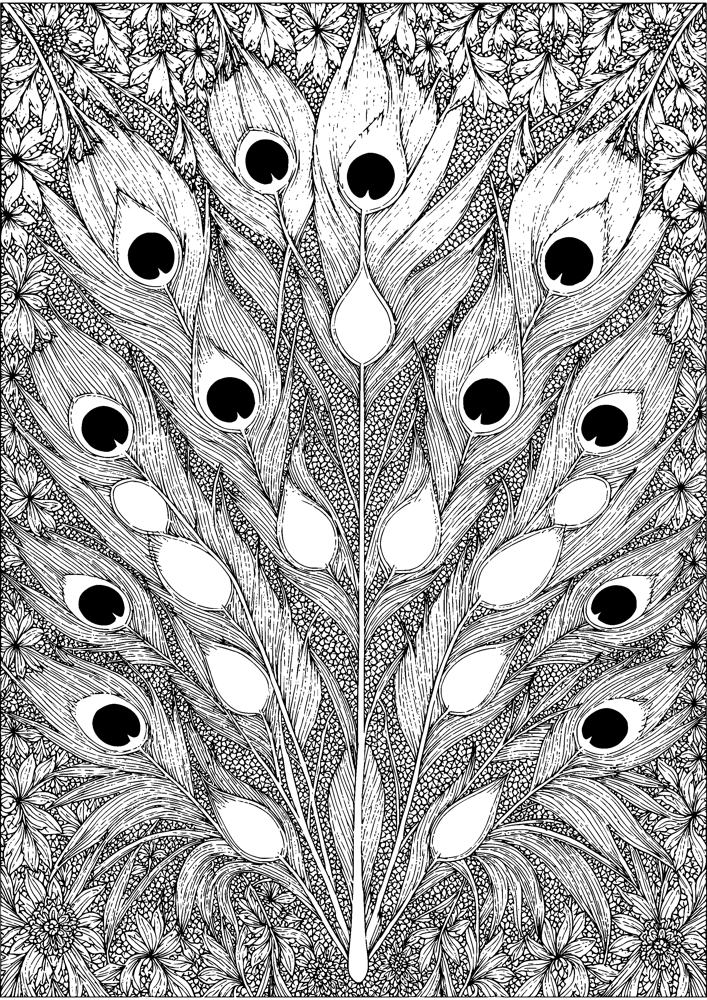
This coloring page features a symmetrical arrangement of stylized peacock feathers fanning outward from a central base. The composition is densely packed, with multiple layers of overlapping feathers that fill the entire frame from edge to edge.
The background is filled with a fine, repetitive mesh pattern, and the outer edges are bordered by a dense frame of small flowers and leaves. The line work is intricate and fine, with hundreds of tiny feather barbs and detailing lines meant for careful coloring with thin pens or sharp pencils.
While this illustration is an imaginary decorative design rather than a scientific study, it borrows heavily from the natural opulence of real peacock plumage. In nature, peacock feathers owe their famous iridescent colors not to pigments, but to microscopic crystal-like structures that reflect light at different wavelengths.
The distinctive eye shape at the tip of each feather is designed to catch the eye of potential mates and confuse predators. In decorative arts, this pattern has been a favorite since the Art Nouveau period, known for its flowing, organic curves and rich symmetry.
To capture the classic look of a peacock, use rich jewel tones like deep emerald green, cobalt blue, and royal purple for the feather eyes and centers. You can color the background mesh in a muted bronze or dark charcoal to make the brighter feathers stand out.
If you prefer to depart from realism, try a warm autumn palette of burnt orange, gold, and copper, or keep the entire page monochromatic with shades of gray and silver for a sophisticated metallic effect.
Because this design features dense background patterns and very fine feather lines, a heavy cardstock is recommended if you plan to use fine-tipped markers or wet media that might bleed. Standard printer paper works well with colored pencils, allowing you to build up subtle shading in the narrow spaces between the barbs.